Abhijeet Dipke: Nationality, Caste, Religion, Net Worth, Family and Everything Else Explained
Three months ago, almost nobody outside a small circle of Indian political communication professionals had heard the name Abhijeet Dipke. Today he is the founder of the fastest growing digital political movement India has seen, the man Delhi Police has detained more than once, and the subject of more Google searches in a single week than most sitting Members of Parliament get in a year.
But ask people what they actually know about him, and the answers get thin fast. Where is he from? Is he married? What is his caste? Does he practice a particular religion? How much is he worth? And what is this “Pune case” that keeps resurfacing every time his name trends?
This page pulls together everything that is actually known, and clearly flags what is not, in one place.
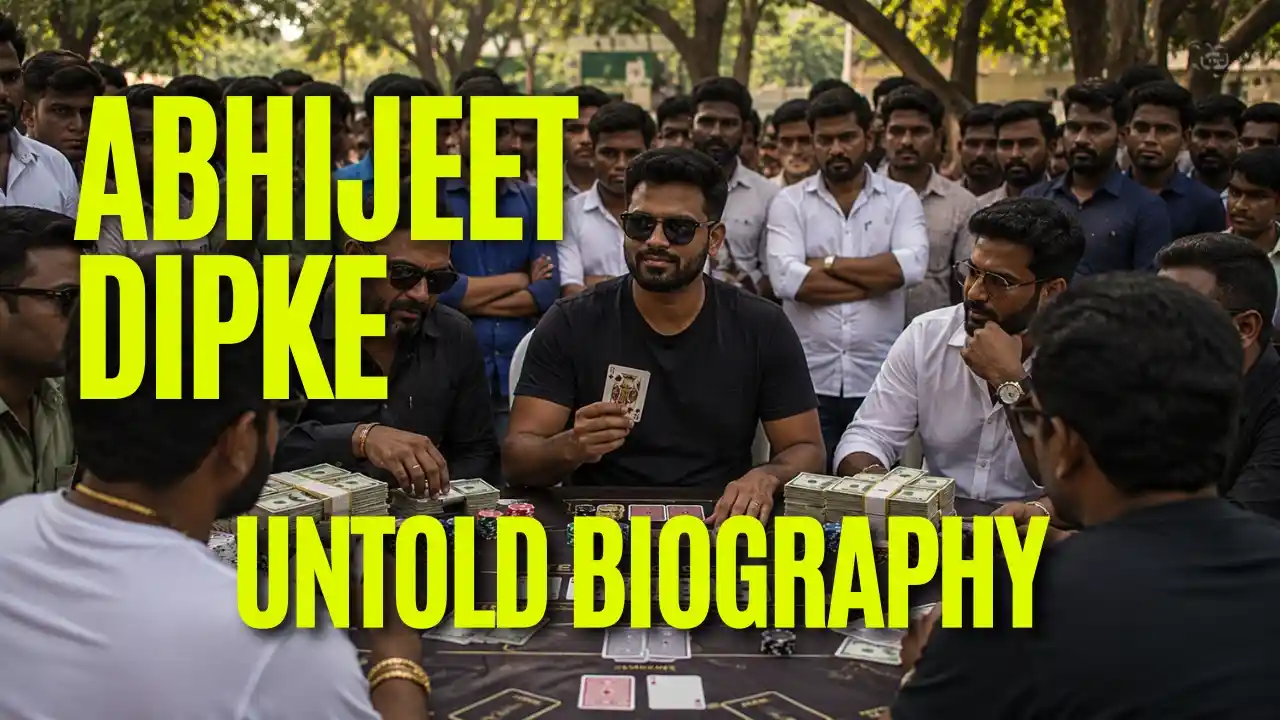
Who Is Abhijeet Dipke?
Abhijeet Dipke is an Indian political communication strategist and the founder of the Cockroach Janta Party (CJP), a satirical political movement that began as an internet joke on 16 May 2026 and turned into one of the largest youth-led mobilisations in recent Indian history within days. A more detailed profile of his rise sits on our page on who Abhijeet Dipke is.

| Quick Facts | Details |
|---|---|
| Full Name | Abhijeet Dipke |
| Born | 29 September 1995 |
| Age | 30 (as of 2026) |
| Nationality | Indian |
| Known For | Founder, Cockroach Janta Party (CJP) |
| Education | Journalism (Pune), Master’s in Public Relations (Boston University) |
| Former Role | Social media volunteer, Aam Aadmi Party (2020 to 2023) |
| Caste | Publicly identifies as Dalit (self-disclosed, May 2026) |
| Religion | Not publicly specified |
| Marital Status | Not publicly disclosed |
| Net Worth | Not verified or disclosed |
Where Is Abhijeet Dipke From? Nationality, Hometown and Roots
Start with the basics that people search for most: is Abhijeet Dipke even Indian, and where exactly does he come from?
Yes. Abhijeet Dipke is an Indian citizen. According to publicly available biographical records, he was born on 29 September 1995 in Aurangabad, Maharashtra, a city officially renamed Chhatrapati Sambhajinagar in 2023. He grew up in Maharashtra before moving to Pune for his undergraduate studies, and later to the United States for his master’s degree.
That last part is where a lot of confusion creeps in. Because Dipke was based in Boston while CJP exploded online, some assumed he had settled abroad permanently or was somehow disconnected from India. Dipke has pushed back on that framing directly, pointing out that the movement’s demands, its protests, and its leadership are rooted entirely in India. He has also said publicly that if the whole thing had been planned in advance, he would not have been running it from the United States at all, he would have been in India from day one.
We go deeper into the hometown question, including the Aurangabad versus Chhatrapati Sambhajinagar naming debate, on our dedicated page about Abhijeet Dipke’s nationality and roots.
What Is Abhijeet Dipke’s Educational Qualification?
Dipke’s education is one of the more solidly documented parts of his biography, and it explains a lot about how CJP was built the way it was.
He completed his bachelor’s degree in Journalism in Pune, giving him an early grounding in media writing, reporting, and public communication. He then moved to the United States to pursue a Master of Science in Public Relations at Boston University’s College of Communication, a program focused on narrative construction, digital campaign strategy, and how communication shapes public perception in the internet age.
That academic background is not incidental. People who worked with him on CJP’s early messaging point to his PR training as the reason the movement had a coherent manifesto, a clear slogan, and a consistent visual identity (a smartphone with antennae) within hours of launch, rather than the scattered, disorganised look most viral internet moments have. Dipke himself has said his coursework stressed the importance of a campaign having a clear vision and mission from day one, and that this shaped how he approached CJP.
For the complete academic timeline, visit our page on Abhijeet Dipke’s qualification.
Abhijeet Dipke and His Aam Aadmi Party Connection
Before Cockroach Janta Party existed, Dipke was already inside the machinery of Indian digital political campaigning, just not as the face of it.
Between 2020 and 2023, he worked as a social media volunteer with the Aam Aadmi Party (AAP). During the February 2020 Delhi Assembly election campaign, which AAP won under Arvind Kejriwal, Dipke focused on meme-driven digital outreach aimed at young voters. That stint gave him firsthand experience in how a comparatively young party could use digital platforms to compete with much larger, better-funded rivals.
He has since said the CJP is fully independent and will not align formally with AAP, the BJP, or any other existing party. But the AAP years are widely seen, including by Dipke himself, as the training ground where he learned the mechanics of turning online attention into an organised following, a skill he would put to dramatically larger use in 2026.
How Did Cockroach Janta Party Actually Start?
Here is the part almost everyone gets slightly wrong: CJP was not a long-planned political project. It was a same-day reaction to a single sentence.
On 15 May 2026, during a Supreme Court hearing, Chief Justice of India Surya Kant made remarks that were widely reported as comparing unemployed young Indians to “cockroaches” and “parasites of society.” The Chief Justice later said his comments were taken out of context. But by the time that clarification came, the internet had already run with it.
Dipke, then a job seeker in Boston who had just completed his master’s, posted a simple question on X: “What if all the cockroaches come together?” Within hours the post was gaining traction. He followed it with a basic sign-up website and the announcement of a satirical outfit called the Cockroach Janta Party, describing it as “Secular, Socialist, Democratic, and Lazy” and the “voice of the lazy and unemployed.”
The response was not gradual, it was explosive. Roughly 50,000 people signed up in the first 24 hours. Within five days, that number crossed a million. The party’s Instagram account grew past 20 million followers within days, reportedly overtaking the BJP’s official Instagram following, and its X account crossed 200,000 followers before being withheld in India following a legal demand.
Membership eligibility, per CJP’s own tongue-in-cheek manifesto, requires being “unemployed by force, choice, or principle,” “chronically online for at least 11 hours a day,” and “emotionally exhausted by the system.” The humour is deliberate. But underneath the memes sits a genuinely serious manifesto, including demands for a ban on post-retirement Rajya Sabha appointments for former Chief Justices, 50 percent reservation for women in cabinet positions, and full transparency under the RTI Act.
For the full breakdown of the founding story, see our detailed page on who Abhijeet Dipke is.
What Is Abhijeet Dipke’s Caste? The Dalit Disclosure That Changed the Conversation
This is one of the few personal details about Dipke that is not a mystery, because he addressed it himself, directly and publicly.
On 21 May 2026, in response to online questions pressing him on CJP’s stance on reservation and social justice, Dipke posted on X: “I am a Dalit myself. I hope that will answer all your questions.”
What followed was not a quiet news cycle. Dipke faced a wave of caste-based abuse and trolling on social media in the days after his post, with critics accusing him of political opportunism and mocking his identity. At the same time, a large number of users publicly condemned the trolling and defended his right to disclose his identity without facing harassment for it. The episode became a story in its own right, separate from CJP’s core protest demands, and was covered extensively by Indian outlets at the time.
It’s worth being precise here: caste and religion are not the same thing, even though people often search for them together. Dipke’s Dalit identity is a caste disclosure, self-made and on the record. It does not, on its own, confirm which religion he follows, since Dalit communities in India span Hinduism, Buddhism, Christianity, Sikhism, and other faiths.
We cover this in more depth, including the reaction from political and social commentators, on our page dedicated to Abhijeet Dipke’s caste.
Does Abhijeet Dipke Follow a Particular Religion?
Short answer: it has not been publicly stated, and there’s no confirmed source to point to.
Unlike his caste, which he addressed himself in a specific, quotable public post, Dipke has not made any comparable public statement about his religious beliefs or affiliation. CJP as a movement has also deliberately avoided framing itself around religion, keeping its messaging focused on unemployment, education, and institutional accountability rather than identity politics of any kind beyond the caste question he chose to answer.
Given how much online curiosity exists around this specific question, it is worth stating plainly: any claim online naming a specific religion for Abhijeet Dipke is not something we could verify against a credible, on-record source at the time of writing. We would rather say that clearly than guess.
Our full breakdown of what is and isn’t known lives on our page about Abhijeet Dipke’s religion.
What Is Abhijeet Dipke’s Net Worth? Why the Number You’ve Seen Online Is Probably Made Up
If you’ve searched this and landed on a page with a specific dollar or rupee figure, treat it with real skepticism.
Dipke’s public profile is built entirely around political communication and youth activism, not business, entertainment, or any commercial venture with disclosed revenue. Weeks before CJP existed, multiple reports described him simply as a recent graduate looking for job opportunities. There is no known salary structure, business holding, endorsement deal, or asset disclosure connected to his name that would allow anyone to calculate a credible net worth figure.
That has not stopped speculative numbers from circulating online, the way they do for almost every viral figure. None of them are traceable to a disclosed source, a financial filing, or a statement from Dipke himself. Until that changes, the honest answer to “what is Abhijeet Dipke’s net worth” is that a verified figure simply does not exist yet.
More detail on why these estimates keep appearing anyway, and what would actually need to happen for a real number to exist, is on our page about Abhijeet Dipke’s net worth.
Is Abhijeet Dipke Married? What About His Parents?
Two of the most searched questions about Dipke, and two of the areas where he has kept the most distance between his public role and his private life.
On marriage: as of 2026, there is no public confirmation that Abhijeet Dipke is married, engaged, or in a publicly disclosed relationship. He has not introduced a spouse or partner in interviews or on his social media accounts, and no verified name of a partner has surfaced in credible reporting. Given how closely his account is followed, this appears to be a deliberate boundary rather than an oversight.
On parents and family: Dipke has generally kept his family out of the public conversation entirely. Mainstream coverage of CJP has focused almost exclusively on his career, education, and the movement itself, not on his parents, siblings, or extended family. Where his hometown has come up, it is in the context of his own upbringing and education, not detailed family biography. We’d rather report that gap honestly than fill it with names and details we cannot verify.
Full detail on both fronts sits on our pages about Abhijeet Dipke’s marriage and Abhijeet Dipke’s parents.
What Is the 2019 Pune Complaint Against Abhijeet Dipke?
This is the part of Dipke’s story that resurfaces every time CJP makes headlines, and it deserves a careful, factual treatment rather than a dramatic one.
In August 2019, an organisation called Legal Rights Observatory reportedly filed a complaint with Pune Police against Dipke, alleging that some of his social media posts around the time of the Article 370 developments in Kashmir promoted narratives sympathetic to separatist positions. According to the complainant, the filing sought action under sections related to sedition and anti-state activity.
Here is the part that matters most and is often left out: according to the same complainant, no FIR was ever registered in the matter, despite repeated follow-ups over the years. He also said he never received any formal written communication from Pune Police on the status of the complaint.
The issue resurfaced in 2026 alongside a separate, more serious claim circulating on social media, that Dipke was an “ISI-paid asset.” Fact-checks into that specific allegation found no publicly available official confirmation or court ruling to support it. In other words, there is a real, documented 2019 complaint that never resulted in formal charges, and there is a separate, unverified conspiracy claim riding on its coattails. Treating the two as the same thing is where a lot of the confusion, and the unfairness to Dipke, comes from.
The full timeline, including what Legal Rights Observatory has said publicly, is on our dedicated page about the Abhijeet Dipke Pune case.
From Meme to Movement: The NEET Protests and the Jantar Mantar Standoff
CJP did not stay a satirical Instagram page for long. By June 2026, it had turned into an organised street movement, and that shift is central to understanding who Dipke has become.
On 6 June 2026, CJP, alongside student organisations, launched a sustained protest at Jantar Mantar in Delhi, later referred to as the “Sansad Chalo” or “Chalo Sansad” march. The trigger was the NEET-UG paper leak controversy, along with irregularities in CBSE evaluation and other examination systems that protesters said had affected over a crore of students. Dipke’s core public demands were consistent throughout: the resignation of Union Education Minister Dharmendra Pradhan, compensation of one crore rupees for the families of students who died by suicide connected to the exam crisis, and the release of activist Sonam Wangchuk, who joined the protest and was later hospitalised after an extended hunger strike.
The protests have not been quiet. Delhi Police imposed prohibitory orders across the New Delhi district, and there have been documented clashes at the site, including baton charges and heavy barricading, as protesters repeatedly attempted to march toward Parliament. Dipke has himself been detained by Delhi Police during the demonstrations. As of this week, the standoff remains unresolved, with the government reportedly sending multiple proposals for talks and CJP announcing further nationwide protest action.
This is a fast-moving, still-developing story, and we are deliberately not speculating on where it goes next. What can be said with confidence is that CJP, and Dipke personally, moved from an internet joke to a sustained, nationally covered protest movement in under two months, which is close to unprecedented for a group with no formal registration as a political party.
Is Abhijeet Dipke on Wikipedia?
Yes. Given the scale and speed of CJP’s rise, both Abhijeet Dipke and the Cockroach Janta Party have Wikipedia entries, along with a separate, actively updated page tracking the 2026 Jantar Mantar protests specifically. These pages document his date of birth, education, the party’s founding date of 16 May 2026, and a timeline of the protest movement, drawing on Indian news coverage as the movement developed.
That said, a Wikipedia page existing is not the same as every detail on it being settled or final, particularly for a figure whose story is still actively unfolding week to week. We’d recommend treating it as one useful reference point among several, which is exactly the approach we’ve taken across this page.
For a structured look at what’s documented there, see our page on Abhijeet Dipke’s Wikipedia entry.
Abhijeet Dipke: Quick Answers to Common Questions
| Question | Answer |
|---|---|
| Is Abhijeet Dipke Indian? | Yes, he is an Indian citizen, born in Maharashtra. |
| What did he study? | Journalism in Pune, followed by a Master’s in Public Relations from Boston University. |
| Did he work with AAP? | Yes, as a social media volunteer from 2020 to 2023. |
| When was CJP founded? | 16 May 2026, following remarks by Chief Justice Surya Kant. |
| Is he married? | Not publicly disclosed. |
| What is his caste? | He has publicly identified himself as Dalit. |
| What is his religion? | Not publicly specified. |
| What is his net worth? | No verified figure exists. |
| Was he expelled from Boston University? | No. Dipke publicly denied this rumour, noting he had already graduated. |
| What is the Pune case about? | A 2019 complaint alleging posts sympathetic to separatist narratives; no FIR was ever filed. |
The Bottom Line
Abhijeet Dipke’s story, at least so far, is really two stories running in parallel. One is about a fast, almost accidental rise built on a single viral post, sharp public relations instincts, and a genuine read on youth frustration in India. The other is about how quickly a private person’s caste, religion, finances, and family become public property the moment that rise happens, whether the facts are actually available or not.
We have tried to keep this page firmly in the first story and honest about the limits of the second. Where something is confirmed, we’ve said so plainly. Where it is not, we have said that plainly too, rather than filling the gap with a number or a name that sounds convincing.
As with any founder’s story worth telling honestly: the facts matter more than the following, and a reputation built on verified ground lasts longer than one built on speculation. That’s the standard EthicalFounder.com holds every profile to.