The A to Z Guide to Seedance 2.0 Prompts: Claude AI Video Prompt Generation & Cinematic Formulas
Looking for the best Seedance 2.0 Prompts? As a researcher who has spent years analyzing the global landscape of AI tools at ethicalfounder.com, I’ve witnessed the rapid evolution of generative video models. Watching the development of ByteDance video AI prompts, one thing has become painfully clear: the industry is currently saturated with low-effort, consumer-level tutorials.
Most professionals searching for text-to-video prompt templates end up with a vague keyword soup designed for social media clips. But what happens when you are working at an elite tier? What happens when a production house or a top-tier director expects Marvel-level cinematic quality, authentic motion blur, anamorphic lenses, and flawless drone tracking shots?
Basic simply doesn’t cut it. You don’t need random tips; you need director-level video prompt formulas. You need to know how to structure prompts so the models do not hallucinate, and you need the actual math and physics parameters to simulate hyper-realistic motion blur and optical characteristics. Furthermore, you need to seamlessly integrate two distinct powerhouses: using a massive language model for complex conceptualization and a video generation model for pixel-perfect execution.
In this comprehensive guide, we are breaking down the absolute A to Z of Seedance prompt engineering. We will explore how to leverage Claude AI prompt generator for Seedance 2.0 automation to create multi-shot storyboards, how to correctly use advanced reference tags, and how to tackle the biggest production failures—from aggressive content filtering to temporal detail collapse.
Why Basic Text-to-Video Prompt Templates Fail in High-End Production
Before diving into advanced techniques, we must understand why the standard approach to AI video generation collapses under professional scrutiny. When multinational companies and commercial directors adopt AI, they are not looking for “pretty” images; they require exacting control over the frame.
The Keyword Soup Problem The most common mistake in generative video is the reliance on adjective stacking. Strings of text like “beautiful, realistic, 8k, cinematic, trending on ArtStation” provide no geometric or optical instructions to the AI. This causes the model to guess the spatial relationships and lighting setups, resulting in the “AI look”—a smooth, plastic aesthetic devoid of real-world physics.
The Morphing Reality and Loss of Physics When basic prompts are used, the resulting videos suffer from severe morphological instability. Without strict camera parameters and depth mapping explicitly codified in the prompt, the AI struggles to maintain the integrity of objects moving through three-dimensional space. The background warps, limbs duplicate, and the physical laws of gravity and momentum are ignored.
Production Realities vs. Algorithmic Dreams High-end production houses require predictable outcomes. A director expects true-to-life camera physics. If a scene dictates a fast pan, the resulting motion blur must mathematically align with the simulated shutter speed and frame rate. Seedance 2.0, when prompted correctly, can understand these optical physics, but only if the prompt is structured as a technical command rather than a creative suggestion.
The Best Seedance Prompt Structure for Cinematic Videos 2026
To achieve Hollywood-tier results, you must shift your mindset from writing descriptive paragraphs to writing technical camera directions. The architecture of a production-ready prompt must follow a rigid structure that dictates every element within the frame.
The ideal formula for Seedance 2.0 prompts is a serialized input sequence: [Subject/Action] + [Environment/Lighting] + [Camera Rig/Movement] + [Lens Specification] + [Motion Physics/Shutter]
To execute this, prompt engineers must familiarize themselves with high-end cinematography vocabulary. Terms like chiaroscuro lighting, Cooke Anamorphic T2.3, 180-degree shutter rule, dolly zoom, and atmospheric perspective are not just stylistic choices; they are the exact parameters Seedance uses to constrain its generation and prevent hallucinations.
Mastering the Seedance Camera Movement Prompt
- 3 Hidden ERISA Exemption Facts: Short Term Disability Denial Lawyer
- Workplace Disability Rights Lawyer: The 2 Moments That Decide Every ADA Case
- AI Hiring Tools Lawyer: The FCRA Loophole Nobody’s Suing Over Yet In United States
- Remote Work Accommodation Lawyer USA: 3 Reasons Courts Reversed
- 3 Undue Hardship Facts Your ADA Accommodation Lawyer Won’t Skip

- EEOC Discrimination Lawyer: The Hidden 300 Day Deadline Trap in the USA


Camera movement in AI generation is often where realism falls apart. Generic panning commands usually result in the background flatly dragging across the screen. To fix this, you must dictate the physical rig.
- Drone Tracking & Extreme Chasing: To simulate high-speed aerial shots, you must instruct the AI on both the speed and the intended optical anomaly. For example, instead of “fast drone shot,” use “FPV drone tracking shot, high velocity, heavy environmental motion blur, maintaining sharp subject focus.”
- Dolly, Crane, and Steadicam: Dictate the stabilization method. “Heavy Steadicam operation” yields a different organic movement than “Precision Technocrane sweeping shot.”
- Extreme Environments & Atmospherics: When prompting for underwater scenes, skyfalls, or massive explosive blasting, control the particulate matter. “Volumetric lighting cutting through thick atmospheric dust, debris tracking toward the lens” forces the AI to render depth layers, drastically increasing realism.
Character Consistency Video Prompts for Seedance
Maintaining a singular identity across multiple shots is the holy grail of generative video. Here is how to achieve it.
How to write Seedance 2.0 prompts that stay consistent Consistency relies on eliminating variables. Rather than describing a character (“tall man with a beard”), define them like a casting sheet (“Subject: Male, 35 years old, distinct facial scar on left cheek, wearing a specific tactical vest, sharp angles”). You must use the exact same character descriptor matrix in every single shot of your sequence.
How to use @reference tags in Seedance prompts correctly Seedance 2.0 allows for image referencing. However, simply uploading an image is not enough and often leads to facial recognition failures. The strict methodology is to provide a neutral-lit, highly detailed portrait as your @reference and then use your text prompt to dictate the lighting and environment around that reference, explicitly stating “retain exact facial geometry of the reference image.”
The Best Seedance Prompt Structure for Cinematic Videos 2026
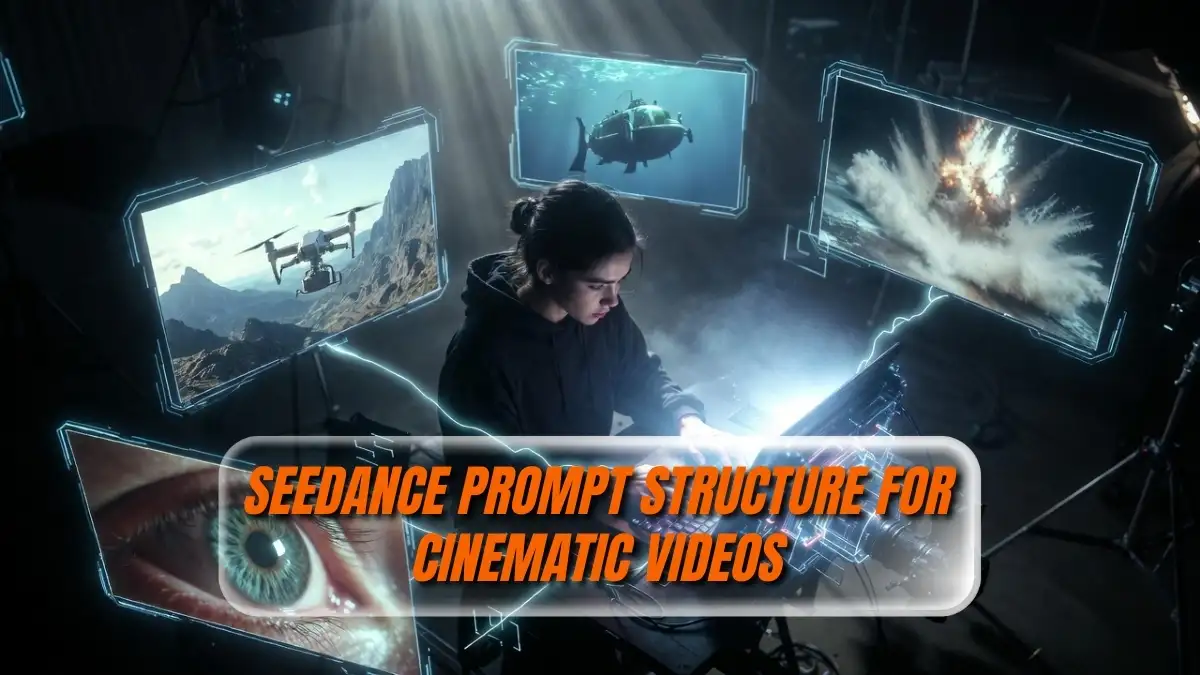
Seedance 2.0 does not process language like a human; it processes it like a rendering engine. Writing prompts as standard sentences causes the natural language processor to guess at spatial relationships. To achieve production-ready video prompt formulas, you must use a rigid, bracketed taxonomy that explicitly isolates camera optics from scene contents.
The Director-Level Parameter Formula
Do not write paragraphs. Use this exact syntax structure to lock the AI into rendering specific optical mathematics:
text[Subject] :: [Kinetics/Action] :: [Environment/Atmosphere] :: [Lighting Rig] :: [Camera Optics: Sensor/Lens/Aperture] :: [Camera Support/Movement] :: [Seedance Engine Parameters]
Essential Syntax Breakdown:
- [Kinetics/Action]: Must strictly define the physics of movement (e.g., rapid lateral displacement, slow-motion fluid dynamics).
- [Camera Optics]: Dictate the exact lens and sensor (e.g., Arri Alexa 65, 35mm Master Prime, T1.4, shallow DOF).
- [Seedance Engine Parameters]: The mathematical constraints for the model (e.g., –ar 2.39:1 –motion-blur 1/48s –temporal-lock 9).
Mastering the Seedance Camera Movement Prompt
To stop backgrounds from dragging flatly across the screen, your Seedance camera movement prompt must specify the mechanical rig:
- Drone Tracking: Use
[Camera Support: FPV Racing Drone, proximity flying, high-velocity target tracking] - Crane/Jib Shots: Use
[Camera Support: 50ft Technocrane, sweeping arc, z-axis descent] - Steadicam: Use
[Camera Support: Heavy Steadicam operator, smooth leading tracking, isolating subject]
10 Free Seedance Video Prompt Templates Copy Paste Ready
These are not standard Text-to-video prompt templates. These 10 prompts are highly technical, deep-layered commands designed for multi-million dollar ad agency aesthetics, utilizing extreme motion blur, dynamic environments, and exact optical physics.
1. Seedance 2.0 Prompt for High-Speed Drone Avalanche Chase
text[Subject: Solo snowboarder in matte black tactical winter gear] :: [Kinetics: Extreme downhill velocity, triggering a massive powder avalanche behind him] :: [Environment: Alpine peak, sheer cliff face, airborne ice crystals] :: [Lighting Rig: Harsh midday alpine sunlight, blinding snow reflection, high-contrast shadows] :: [Camera Optics: 14mm Ultra-Wide, infinite focus, f/8] :: [Camera Support: FPV Drone tracking from behind, aggressive banking, violent camera shake on impact] :: [Seedance Parameters: –ar 16:9 –motion-blur heavy –shutter-angle 90 –temporal-lock 10]
2. Video Prompt for Cyberpunk Macro Iris Reflection
text[Subject: Human-synthetic eye, extreme macro close-up] :: [Kinetics: Pupil dilating rapidly, mechanical iris clicking into place] :: [Environment: Reflected in the cornea is a neon-lit, sprawling mega-city highway with flying traffic] :: [Lighting Rig: Strobing magenta and cyan neon tubes off-camera] :: [Camera Optics: 100mm Macro lens, Arri Alexa LF, T2.8, extreme shallow depth of field, sharp focus solely on the iris] :: [Camera Support: Locked-off tripod, micro-vibrations] :: [Seedance Parameters: –ar 2.39:1 –motion-blur zero –sharpness high]
3. Underwater Bioluminescent Submersible Seedance 2.0 Video Prompt
text[Subject: Sleek, black deep-sea stealth submersible] :: [Kinetics: Gliding silently, displacing heavy water, propellor cavitation bubbles] :: [Environment: Mariana Trench depth, pitch black, surrounded by glowing bioluminescent jellyfish] :: [Lighting Rig: Single high-intensity halogen searchlight cutting through dense aquatic silt] :: [Camera Optics: 35mm Anamorphic, heavy edge vignetting, underwater housing distortion] :: [Camera Support: Lateral ROV tracking shot, weightless floating movement] :: [Seedance Parameters: –ar 2.39:1 –motion-speed slow –shutter 1/24s]
4. Trench Warfare Artillery Shockwave
text[Subject: Massive mechanized artillery cannon] :: [Kinetics: Violent recoil mechanism firing, ground shattering, ejecting brass shell] :: [Environment: World War I style muddy trench, torrential downpour, midnight] :: [Lighting Rig: Pitch black shattered instantly by blinding white-hot muzzle flash, intense chiaroscuro] :: [Camera Optics: 24mm wide lens, T1.4, sensor overload/rolling shutter artifact on flash] :: [Camera Support: Low-angle ground mount, extreme impact vibration] :: [Seedance Parameters: –ar 16:9 –shutter-angle 45 –motion-blur zero –dynamic-range max]
Recent Prompt Trends
- Grok Stunning Girl Prompts
- Gemini Paparazzi Image Prompts
- Gemini Tattoo Babe’s
- Sad Boy Image Prompts
- Love Failure Image Prompts for Boys
- Winter Prompts for Cute Girls
- Girl Prompts “Snow Effect”
- Islamic Girl AI Image Prompts
- Hijab Prompts for Muslim Girls
- Nibba Nibbi Image Prompts
- 10 Uncensored Grok Prompt Ideas
- Grok Prompts for Athletic Fashion Content
- Winter Photography Prompts
5. Hyper-Lapse Neon Highway Pursuit
text[Subject: Chrome sports car] :: [Kinetics: Weaving aggressively through dense traffic, hydroplaning slightly] :: [Environment: Wet asphalt mega-city highway, rain streaks] :: [Lighting Rig: Golden sodium vapor streetlamps, red LED taillight streaks] :: [Camera Optics: 18mm lens, f/11 for deep focus] :: [Camera Support: Russian Arm mounted to lead vehicle, hyper-lapse time manipulation] :: [Seedance Parameters: –ar 2.39:1 –motion-blur extreme-horizontal –framerate-sim 12fps]
6. Atmospheric Zero-Gravity Debris Field
text[Subject: Shattered solar panel array and tumbling astronaut] :: [Kinetics: Uncontrolled multi-axis spin, micro-collisions of glass debris] :: [Environment: Low Earth orbit, pure black void of space, Earth rim light in deep background] :: [Lighting Rig: Unfiltered, harsh directional solar lighting, pitch-black cast shadows] :: [Camera Optics: 50mm Master Prime, perfect edge-to-edge sharpness, zero atmospheric distortion] :: [Camera Support: Unstabilized free-floating camera, slow z-axis drift] :: [Seedance Parameters: –ar 16:9 –motion-sync high –physics zero-g]
7. Seedance 2.0 Prompt for Extreme Dust Storm Convoy
text[Subject: Three heavy-duty armored transport trucks] :: [Kinetics: Smashing through dunes, tires throwing massive plumes of sand] :: [Environment: Sahara desert, apocalyptic category-5 sandstorm, zero visibility] :: [Lighting Rig: Diffused, choking yellow ambient light, headlights cutting volumetric beams through the dust] :: [Camera Optics: 800mm Extreme Telephoto, severe heat mirage distortion, compressed perspective] :: [Camera Support: Helicopter side-tracking, wind buffeting] :: [Seedance Parameters: –ar 2.39:1 –particle-density extreme –motion-blur standard]
- ChatGPT Is Not Working Today: The Real Reason Behind the Outage (And What Actually Fixes It)
- The Unstoppable Surge: AI Video Generation Cost Reduction Dominates Production
- 45 Days of Hubris: The Real Highguard Shutdown Reasons & The Death of a Hero Shooter
- 300% Faster Strikes: The Claude AI Battlefield Role in Israel Iran AI Warfare




8. Close-Quarters Combat (Saving Private Ryan Style)
text[Subject: Two special forces operatives in tactical gear] :: [Kinetics: Brutal, fast-paced hand-to-hand combat, rapid blocking and striking] :: [Environment: Claustrophobic concrete stairwell, debris on the floor] :: [Lighting Rig: Flickering fluorescent overhead tube, cold blue tint] :: [Camera Optics: 35mm lens, Arri 416 film simulation, high grain] :: [Camera Support: Handheld, aggressive reactive panning, snapping focus] :: [Seedance Parameters: –ar 16:9 –shutter-angle 45 –framerate-sim 24fps –staccato-motion true]
9. Seedance 2.0 Prompt Tips for Product Demonstration Videos
text[Subject: High-end titanium smartwatch with glowing holographic dial] :: [Kinetics: Watch rotating slowly 360-degrees on an invisible axis] :: [Environment: Absolute black studio void, floating liquid metal droplets circulating the watch] :: [Lighting Rig: Precision dual-strip rim lighting, catching the metallic micro-texture bevels] :: [Camera Optics: 100mm Macro Cine Lens, T2.1, razor-thin focal plane tracking the front bezel] :: [Camera Support: Robotic motion-control arm (Bolt), perfectly smooth infinite orbit] :: [Seedance Parameters: –ar 16:9 –sharpness extreme –motion-blur zero]
10. Aerial Skyscraper Glass Reflection unsig Seedance 2.0 Prompt
text[Subject: A base jumper entering terminal velocity] :: [Kinetics: Falling headfirst parallel to a massive glass skyscraper] :: [Environment: Sunrise over a dense metropolis, volumetric fog rolling through the streets below] :: [Lighting Rig: Golden hour reflection off the glass facade, blinding specular highlights] :: [Camera Optics: 20mm ultra-wide, f/5.6] :: [Camera Support: Helmet-mounted rig looking back up at the jump point, rapid recession] :: [Seedance Parameters: –ar 9:16 –motion-blur vertical-heavy –temporal-lock 9]
Claude AI Prompt Generator for Seedance 2.0 Automation
To construct an entire short film, you cannot write prompts one by one. You must utilize a massive language model as your automated Director of Photography. Developing a highly specialized Claude AI video prompt skill allows you to convert a basic script into a mathematically perfect storyboard.
Multi-Shot Storyboard Prompts for Seedance AI Video
By feeding Claude AI the parameter formula established above, you can execute Multi-shot video prompt storyboarding.
Prompting Claude AI for Automation: “Act as a Hollywood Cinematographer. I am providing a 30-second action script. Convert this script into 8 sequential Seedance 2.0 prompts. You MUST use this exact output structure: [Subject] :: [Kinetics] :: [Environment] :: [Lighting] :: [Optics] :: [Support] :: [Parameters]. Maintain exact environmental lighting and character descriptions across all 8 shots to ensure continuity. Only vary the Camera Optics and Camera Support to create a dynamic edit.”
How to Fix Morphing and Consistency Issues in Seedance Prompts
Even with strict parameter prompting, the Seedance engine requires precise handling to bypass core rendering failures.
Character Consistency Video Prompts for Seedance
How to write Seedance 2.0 prompts that stay consistent: Consistency demands variables be eliminated. Never use relative terms like “pretty” or “tall.” Define subjects with rigid data points: “Male, 40s, sharp jawline, horizontal scar on left brow, wearing a tactical nylon vest.” This exact string must be copied into the [Subject] parameter for every shot.
How to use @reference tags in Seedance prompts correctly: Seedance often merges reference images improperly. Upload a neutrally lit, flat character portrait as your @reference. Then, in your text prompt, strictly define the new lighting and environment, adding the command: [Subject: Retain exact geometric facial structure of reference image].
Fixing Temporal Detail Collapse
When a video looks flawless for two seconds before the background melts into a vague soup, you have hit Temporal Detail Collapse. This occurs when the AI runs out of structural compute for background elements during heavy motion.
The Fix: You must calculate and command the precise motion blur. If you are executing a fast tracking shot, use [Seedance Parameters: --shutter-angle 180 --motion-blur horizontal]. By mathematically telling the AI to blur the background using realistic optical equations, you prevent it from trying (and failing) to render sharp background details frame-by-frame, completely eliminating the morphing effect.