Antigravity Local Legal Drafting: The Ultimate Guide to Data-Sovereign AI
The rapid integration of artificial intelligence into the legal sector has triggered a paradigm shift in how attorneys approach their daily tasks. From drafting contracts to summarizing mountains of discovery documents, the allure of unprecedented efficiency is undeniable. However, this technological leap has introduced a severe ethical dilemma: how can legal professionals harness state-of-the-art AI while upholding the sacred duty of client confidentiality? The answer lies in the shift away from consumer-grade cloud platforms and toward localized, air-gapped solutions.
Antigravity local legal drafting represents the apex of this movement. By running powerful generative models directly on a law firm’s own secure infrastructure, attorneys can achieve massive productivity gains without transmitting a single byte of sensitive data to third-party servers. This comprehensive guide details how data-sovereign AI is revolutionizing the practice of law, protecting client trust, and mitigating the immense risks associated with public cloud computing.

Why Antigravity Legal Automation is Essential for Modern Law Firms
The legal landscape is governed by strict ethical guidelines regarding technological competence and privacy. The American Bar Association (ABA) and various international bodies mandate that lawyers must understand the risks of the technologies they use. Sending confidential case details, personally identifiable information (PII), or proprietary trade secrets to a public AI chatbot inherently risks exposing that data to external human reviewers or commercial training models. Antigravity legal automation eliminates this risk entirely by severing the cord to the public cloud, keeping all computations strictly within the firm’s controlled perimeter.
Best Practices for Attorney Data Privacy When Using AI Tools
The foundational rule of modern legal technology adoption is simple: if you do not control the database, you cannot guarantee the data’s safety. Implementing the best practices for attorney data privacy when using AI tools requires a fundamental shift in infrastructure. Firms must establish strict policies prohibiting the use of open-source cloud models for client matters. Instead, they should invest in localized deployment environments where inputs, prompts, and generated outputs are stored exclusively on encrypted company drives. This “privacy-by-design” approach ensures compliance with state bar ethics opinions that increasingly warn against the careless utilization of external AI vendors.
Local LLMs for Attorney Confidentiality: Protecting the Privilege
Waiver of the attorney-client privilege is perhaps the most catastrophic consequence of mishandled legal tech. If a lawyer inadvertently shares privileged communications with a third-party AI provider whose terms of service permit data retention, opposing counsel could argue that the privilege has been waived. utilizing Local LLMs for attorney confidentiality is the only foolproof defense against this argument. A Local Large Language Model (LLM) processes language natively on your local machine or internal private server. Because the data never traverses the open internet or rests on a vendor’s public server, the expectation of privacy remains absolute, legally fortifying the privilege against any discovery challenges.
Building an Antigravity Secure Legal Workflow
Transitioning from legacy systems or risky cloud platforms to a hardened local environment requires strategic planning. The goal is to build an Antigravity secure legal workflow that is invisible to the end-user but entirely airtight on the backend. This means deploying tools that operate seamlessly on native operating systems (like Windows or local Linux servers) to automate tasks directly within the firm’s firewall.
The Importance of Zero Data Retention AI for Law Firms
When evaluating technology vendors, the phrases “encrypted in transit” or “secure cloud” are no longer sufficient. Law firms handle highly sensitive financial data, medical records, and intellectual property. Therefore, the gold standard is zero data retention AI for law firms. This architecture ensures that once a session is closed or a document is generated, the prompt data is instantaneously wiped from the system’s active memory. No logs are kept for commercial retraining, no usage data is harvested, and no digital footprints are left behind. Antigravity operates on this fundamental principle, guaranteeing that your firm’s intellectual labor is not quietly siphoned off to improve a global algorithm.
Guide to Avoiding GDPR Breaches with Local Legal Automation
For firms operating in Europe or dealing with EU clients, the General Data Protection Regulation (GDPR) imposes crushing penalties for the mishandling of personal data. Sending a client’s health records or financial history to an unauthorized offshore AI server is a textbook violation. Our definitive guide to avoiding GDPR breaches with local legal automation emphasizes data sovereignty. By ensuring that all AI processing occurs on-premise, law firms maintain absolute control over the “where” and “how” of data processing. You never have to worry about cross-border data transfer agreements or vendor sub-processors, because the data never leaves the room.
Antigravity Legal Document Automation: Transforming Practice Efficiency
Beyond the absolute necessity of security, the core value proposition of localized AI is raw operational efficiency. Antigravity legal document automation drastically reduces the time required to originate complex legal texts. By feeding local models structured templates and specific case facts, lawyers can generate highly accurate first drafts of customized legal instruments in seconds rather than hours. This allows practitioners to transition from the role of a structural drafter to a strategic reviewer, significantly increasing the volume of work a single attorney can comfortably handle.
- 3 Hidden ERISA Exemption Facts: Short Term Disability Denial Lawyer
- Workplace Disability Rights Lawyer: The 2 Moments That Decide Every ADA Case
- AI Hiring Tools Lawyer: The FCRA Loophole Nobody’s Suing Over Yet In United States
- Remote Work Accommodation Lawyer USA: 3 Reasons Courts Reversed
- 3 Undue Hardship Facts Your ADA Accommodation Lawyer Won’t Skip

- EEOC Discrimination Lawyer: The Hidden 300 Day Deadline Trap in the USA


How to Automate Legal Document Drafting Locally Without Cloud Risks
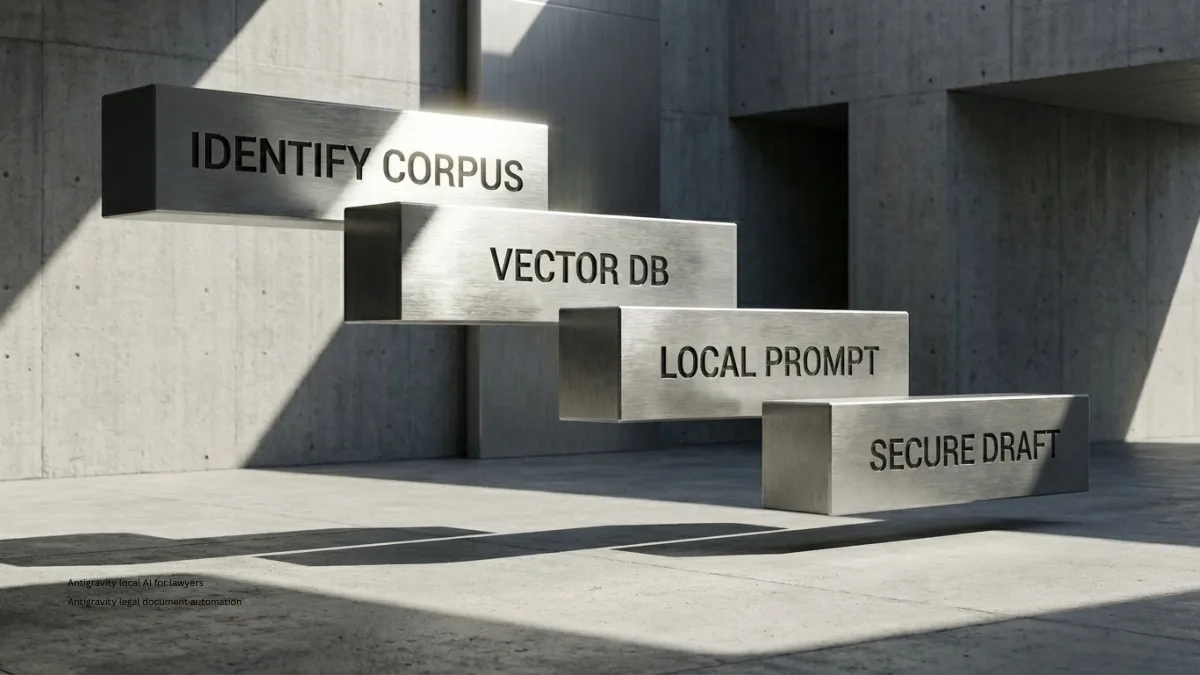
The transition to localized drafting starts with identifying repetitive document types. Here is exactly how to automate legal document drafting locally without cloud risks:
- Identify the Corpus: Gather your firm’s most successful, thoroughly vetted templates and prior agreements.
- Establish a Local Vector Database: Use Antigravity to create an offline, searchable index of these documents that your local AI can reference.
- Prompt Locally: Input the specific variables for your new client (names, dates, jurisdiction-specific terms) directly into your localized interface.
- Generate and Refine: The local engine pulls phrasing from your historical database and perfectly aligns it with the new variables, producing a secure draft without ever pinging an external API.
Legal Tech for Non-Disclosure Agreements and Routine Contracts
High-volume, low-margin tasks often consume an unacceptable amount of associate bandwidth. Implementing localized legal tech for non-disclosure agreements and routine vendor contracts is a massive force multiplier. Because NDAs adhere to standard structures but require precise handling of defined terms and restrictive covenants, localized automation can instantly process a term sheet and output a flawless NDA. The firm immediately captures higher realization rates on flat-fee services, turning previously tedious administrative work into a highly profitable, streamlined operation.
Deep Dive: Private AI Solutions for Processing Sensitive eDiscovery Files
Litigation is won and lost in the discovery phase. Historically, sorting through millions of emails, gigabytes of financial records, and unorganized text files required armies of junior lawyers billing thousands of hours. Today, AI can process this data instantaneously—but doing so securely is paramount. Deploying private AI solutions for processing sensitive eDiscovery files brings the power of machine learning behind your firewall, allowing you to synthesize, tag, and extract critical facts from massive datasets without risking a catastrophic data breach.
Secure Local AI Document Review vs. Cloud Processing
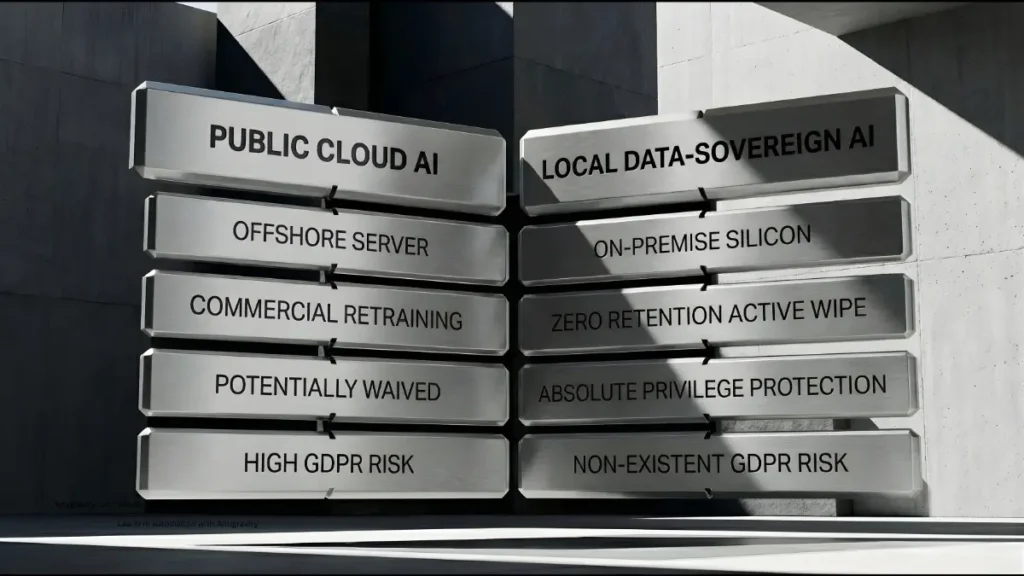
When faced with a “second request” in an antitrust merger or a massive medical malpractice discovery dump, the instinct might be to upload everything to a fast cloud provider. This is a severe error. The difference between secure local AI document review and cloud processing is the difference between retaining control of the narrative and surrendering it. Cloud processing exposes unredacted, highly sensitive corporate or medical data to third-party infrastructure vulnerabilities. Antigravity’s local parsing engines process heavy file types (PDFs, PSTs, DOCX) directly on the firm’s hardware. You get exactly the same speed in identifying “smoking gun” emails or chronological inconsistencies, but with zero external exposure.
Private AI Contract Analysis and Risk Mitigation
In the context of mergers, acquisitions, and real estate transactions, due diligence requires meticulously reviewing hundreds of active contracts. Private AI contract analysis acts as a localized, tireless paralegal. By running Antigravity against a local repository of target company contracts, the AI can instantly flag non-standard indemnification clauses, change-of-control provisions, and unusual termination rights. Because this risk mitigation happens locally, the target company’s proprietary agreements are never subjected to the cybersecurity vulnerabilities of a public SaaS platform.
Using On-Premise Automation to Review Legal Contracts Safely
Translating these capabilities to everyday transactional work requires standardizing how documents are ingested and analyzed. Using on-premise automation to review legal contracts safely means setting up dedicated local folders where received contracts are automatically scanned by the AI against your firm’s internal “playbook.” If opposing counsel sends a draft software licensing agreement, your local agent can compare it line-by-line against your firm’s preferred language, generating a robust redline and a summary memo highlighting areas of unacceptable liability—all before you have even poured your morning coffee.
AI Legal Research Without Data Tracking: Unbiased Case Prep
One often-overlooked danger of using public AI or traditional online legal research databases is that your search queries leave a trail. If a vendor tracks your behavioral data, your litigation strategy could theoretically be deduced or leaked. Conducting AI legal research without data tracking is a critical advantage. By querying localized databases of case law and statutes using Antigravity’s offline semantic search, you ensure that your novel legal theories, specialized focus areas, and tactical preparation remain completely hidden from competitors and data brokers. Unbiased, untracked case preparation is the ultimate form of strategic silence.
Antigravity AI for Solo Practitioners and Boutique Practices
There is a misconception that localized, data-sovereign AI requires a multi-million dollar enterprise IT budget and a floor full of server racks. This is no longer mathematically or technically true. Antigravity AI for solo practitioners and boutique practices democratizes high-end legal tech. Modern consumer hardware—such as high-end laptops or a single workstation equipped with robust local processing power—is more than capable of running advanced legal automation scripts. This levels the playing field, allowing a three-person boutique to process discovery and draft contracts at the speed of an AmLaw 100 mega-firm.
How to Set Up Zero Data Retention Automation for Small Law Firms
For managing partners of boutique firms, the implementation roadmap is highly accessible. Knowing how to set up zero data retention automation for small law firms begins with auditing your current hardware stack.
- Hardware Allocation: Designate a single, powerful local machine (or secure local server) to act as the processing hub.
- Execution Environment: Install the Antigravity local agent, ensuring it is sandboxed and does not require active internet connections to execute its core drafting logic.
- Workflow Routing: Direct your paralegals and associates to place raw data (client intake forms, draft contracts) into specific, locally networked folders monitored by the automation scripts. Within days, the boutique practice transforms into a highly leveraged, hyper-efficient operation.
Choosing On-Premise Legal Automation Software
The procurement phase is critical. When choosing on-premise legal automation software, you must interrogate vendors fiercely on their definition of “local.” True Antigravity private legal tech does not simply create an isolated instance on an Amazon Web Services cloud; it executes the binary code directly on the silicon sitting in your physical office. Look for solutions that advertise strictly local runtime execution, open-weight transparency, and an explicit commitment that the underlying models function fully offline if the ethernet cable is literally unplugged from the wall.
Automating Law Firm Workflows Without Compromising Client Privacy
Ultimately, the goal is total operational harmony. Automating law firm workflows without compromising client privacy means looking at the lifecycle of a case—from the moment a potential client fills out a contact form to the final filing of a brief—and replacing manual bottlenecks with local digital agents. Efficiency should never be a trade-off for ethics; with local deployment, they operate in tandem, driving both profitability and an ironclad reputation for security.
Automated Client Intake Local Hosting: Securing the First Step
The vulnerability often begins at the very first touchpoint. When an anxious client provides their personal narrative, financial status, or medical history via a web form, where does that data go? Utilizing automated client intake local hosting ensures that the data submitted via secure portals drops directly into your local encrypted database, bypassing third-party CRM clouds. An Antigravity local script can instantly read that intake form, identify the relevant legal deadlines, cross-check for conflicts of interest within your local database, and draft an initial consultation brief for the attorney.
(For a comprehensive guide on making this immediate transition, stay tuned for our upcoming deep-dive technical tutorial: “How to start Automating law firm workflows using Antigravity,” which will provide exact codebase instructions and infrastructure maps.)
Integrating Secure AI into Local Law Practice Management Software
The final piece of the puzzle is integration. The best AI is useless if it exists in a silo. Integrating secure AI into local law practice management software (or securely managed on-premise platforms) allows your automation to take action. When a localized AI script finishes drafting a complaint, it should be natively capable of dropping that draft into the correct client folder, updating the local docketing system, and logging the drafted time—all via local network API calls that never cross the firm’s physical threshold.
Conclusion: Law Firm Automation with Antigravity
The legal profession is built entirely upon a foundation of trust. In an era where data breaches are daily news and cloud providers continually erode privacy boundaries, law firms must make a definitive choice about where their client data resides. Law firm automation with Antigravity proves that you do not have to forfeit the bleeding edge of artificial intelligence to maintain your ethical obligations. By bringing the immense cognitive power of AI locally, you secure your clients, you secure your practice, and you secure your future.
The Best Secure AI Tools for Maintaining Attorney-Client Privilege
As the technological arms race accelerates, the distinction between a competitive law firm and an obsolete one will not be whether they use AI, but how safely they use it. The best secure AI tools for maintaining attorney-client privilege will always be those over which the attorney exercises absolute, physical control. Localized, data-sovereign AI is not just a technological luxury; it is rapidly becoming an ethical and operational mandate for the modern legal professional.
Example Antigravity Local Legal Drafting Prompts for Beginners
Are you ready to start testing local AI but unsure where to begin? Use these three naturally integrated prompts to motivate your team and safely explore the capabilities of your localized Antigravity setup:
- The Safe Contract Evaluator Prompt
“Antigravity, please review the attached commercial lease agreement located in my local drive [Folder Path]. Acting as a senior real estate attorney, identify any non-standard indemnification clauses and suggest three redline revisions to better protect our client, the tenant. Execute this strictly locally and confirm no external APIs are called.
“ Why it works: It trains beginners to explicitly command local-only execution while experiencing the immediate ROI of automated document review.
- The eDiscovery Chronology Builder Prompt
“Read the folder of internal company emails located at [Local Path]. Extract every date, sender, and recipient mentioned regarding ‘Project Alpha’. Output a highly structured, chronological timeline in Markdown format detailing the progression of events. Flag any communication gaps longer than 48 hours.”
Why it works: It demonstrates the sheer processing power of local AI in handling tedious eDiscovery tasks, turning days of paralegal work into seconds.
- The First-Draft Generator Prompt
“Using our firm’s standard mutual NDA template saved at [Local Pathway], draft a new agreement between our client [Client Name/Local Variable] and [Counterparty Name]. Ensure the governing law is set to Delaware and the non-solicitation period is modified to 24 months. Generate this document securely and save the output to my local desktop.”
Why it works: It builds immense confidence. By automating routine legal drafting entirely within their own secure environment, lawyers instantly realize they can scale their output without ever sacrificing privacy.